


New to the ISC2 CC Domains? Here's What Each One Actually Means as a Learner
Updated: Jun 21

Not another study guide. Just a real breakdown of all five domains from someone five days out from the exam — what they actually test, what caught me off guard, and what actually matters if you're coming from a non-IT background.
ISC2 already has a study guide. It's thorough, it's official, and it does exactly what a study guide is supposed to do. This isn't that.
This is the post I went looking for when I started and couldn't find — the one that answers the questions the study guide doesn't ask. Not what is in each domain, but why it matters, what it actually looks like when someone's doing the job, and what to expect going in if your background isn't traditional IT.
I'm a Senior Data Analyst. I have an M.S. in Atmospheric Sciences. I've spent years finding anomalies in datasets — healthcare, government procurement, ad policy. I didn't come to this exam the traditional way, no prior IT certificates, no security job — just a side-door entrance and a lot of curiosity. And let me tell you: these five domains landed nothing as I expected. Let me tell you how.
A Quick Note Before We Dive In
The ISC2 CC covers five domains. Each one represents a slice of how security professionals actually think and work — not isolated islands, but interconnected layers of the same discipline. I'll get to that interconnection at the end, because it's the thing that surprised me most.
If you're considering the CC, here's what I want you to take from this post: you don't need an IT background to find these concepts familiar. You need to have ever cared about whether something was accurate, available, and protected. The CC exam doesn't test whether you've memorized every protocol. It tests whether you can think like a security professional. Those are different things.
The Five Domains, Translated
Domain 1
Security Principles
This is the foundation everything else is built on, and it centers on three ideas you'll see everywhere in security: Confidentiality, Integrity, and Availability — the CIA triad.
Information should only be seen by the right people. It should only be changed by the right people or processes. And it should be there when it's needed.
What the study guide doesn't tell you is that this isn't just exam vocabulary. It's a diagnostic framework. When something goes wrong in a security environment, the first question you ask is which of the three got violated — and that shapes everything that comes next.
For me, this domain clicked immediately. Detecting anomalies in atmospheric data, flagging outliers in healthcare records, catching policy violations in ad platforms — I was doing CIA thinking without knowing it had a name. If you've ever worked with data and cared about whether it was correct and accessible to the right people, this domain is going to feel like recognition, not learning.
Domain 1 also covers ethics and security governance — things like why security policies exist and what role different people play in enforcing them. Less thrilling on the surface, but genuinely important for understanding the why behind everything else.
Real-world translation
The three questions every security professional asks when something breaks
If you come from data
Anomaly detection, data accuracy, access governance — you already speak this language
Expect this on the exam
Scenario questions that ask you to identify which CIA principle is at risk
Domain 2
Business Continuity, Disaster Recovery & Incident Response
Domain 2 is essentially about one question: what does your organization do when something goes wrong? Business continuity planning (BCP) is the big-picture strategy for keeping operations running during a disruption. Disaster recovery (DR) is the technical playbook for getting systems back online. Incident response (IR) is the immediate action you take when an attack or failure happens.
What makes this domain click in a real-world context is understanding that the plan matters more than the response. Organizations that scramble after an incident usually didn't have a plan before one. The CC tests whether you understand the difference between having a process and improvising one.
Coming from healthcare analytics, this wasn't abstract to me. I'd seen what happens when accuracy, availability, or protection breaks down. When data pipelines break in a clinical setting, the stakes are real — decisions get made on bad information. Having a recovery plan isn't bureaucracy; it's what separates a bad day from a catastrophic one. That stakeholder awareness transferred directly to this domain.
It also covers concepts like RPO (Recovery Point Objective) and RTO (Recovery Time Objective) — how much data can you afford to lose, and how long can you afford to be down? These are business decisions as much as technical ones, which is part of what makes this domain feel grounded in something real.
Real-world translation
What's your plan for when things break — and do you have one before you need it?
If you come from data
Data pipeline failures, SLA accountability, reporting under pressure — similar stakes
Expect this on the exam
Questions about plan types, priority order of recovery, and what IR phases look like
Domain 3
Access Controls
Domain 3 is about a deceptively simple set of questions: who gets in, how do you verify it's really them, and what can they do once they're inside? Access controls cover both physical access (doors, badges, data centers) and logical access (passwords, MFA, role-based permissions).
The principle underneath all of it is least privilege — people and systems should have access to exactly what they need for their job, and nothing more. Not because you distrust your colleagues, but because the smaller the blast radius of a compromised account, the better. When something goes wrong — and something always goes wrong — least privilege is what keeps it contained.
This domain felt immediately familiar from data work. Managing who has access to which database, setting up role-based permissions in BI tools, flagging when someone pulls data outside their normal scope — that's access control thinking applied to a data environment. The vocabulary is different, but the logic is the same.
The CC also covers authentication methods here in real depth: something you know (password), something you have (a physical token or phone), something you are (biometrics). Multi-factor authentication combines at least two of these — and understanding why that matters is more useful than memorizing the definition.
Real-world translation
Who gets in, how you know it's really them, and how much damage they can do if they're not
If you come from data
Database permissions, role-based access in BI tools, data governance policies
Expect this on the exam
Authentication types, least privilege scenarios, and physical vs. logical access questions
Domain 4
Network Security
⚠ This one required the most work
I'm going to be honest with you about Domain 4, because I think it's the most important thing I can tell someone coming from a non-networking background: this domain will require dedicated time if you haven't lived in network infrastructure. Set aside extra for it. Don't assume your general tech literacy will carry you through.
Network Security covers how data moves — protocols, ports, firewalls, VPNs, network segmentation, wireless security, and the threats that target each layer. The idea is understanding not just that networks exist, but how attackers move through them, where they look for gaps, and how defenders build walls in the right places.
What finally helped this click for me wasn't memorizing every protocol. It was thinking about networks the way I think about data pipelines — there's a source, a destination, a path in between, and places along that path where things can go wrong or be intercepted. Once I started mapping network concepts onto that mental model, they stopped feeling distant.
Concepts like VLANs (virtual network segments that isolate traffic), DMZs (buffer zones between public and internal networks), and defense in depth (layering security controls so no single failure is catastrophic) all make more intuitive sense when you think about why they exist rather than just what they are. They're architectural answers to specific threat scenarios.
I spent extra time here. I'm glad I did. If you're in the same position, don't skip it, hoping it'll be a small percentage of the exam. It won't be.
Real-world translation
How data moves, where it's exposed, and how you build walls in the right places.
If you come from data
Think: data pipeline with attack surfaces at every handoff. The logic transfers — the vocabulary doesn't.
Expect this on the exam
Network threats, firewall types, segmentation strategies, wireless security — budget real study time here.
Domain 5
Security Operations
If the other domains are the strategy, Domain 5 is the daily practice. Security operations cover what security professionals actually do every day: monitoring systems for anomalies, handling data securely, applying encryption, managing logs, responding to incidents, and making sure the environment stays healthy over time.
This domain felt the most like home for me. Log analysis, pattern recognition, SQL queries against security data, spotting something that doesn't belong in a dataset — that's the work. I ran a live threat-hunting investigation against a real Zeek network log file and uncovered evidence of a Mirai botnet. I wrote about this in a previous post. That was Domain 5 thinking in practice, before I had the vocabulary to call it that.
Domain 5 also covers data handling concepts — how to classify data by sensitivity, how to handle it through its lifecycle, and how to dispose of it properly. For anyone who's worked with PII, HIPAA data, or government procurement records, this will feel like familiar territory with new framing.
Encryption gets real coverage here too — not at a deep cryptographic level, but at the level of understanding why it matters, when to use it, and what "encryption in transit vs. at rest" actually means in practice.
Real-world translation
The day-to-day of a security role — watching, logging, flagging, responding, repeating
If you come from data
Log analysis, anomaly detection, data classification — this is the domain that rewards a data background most
Expect this on the exam
Data handling, encryption use cases, monitoring concepts, and incident response overlap from Domain 2
The Thing That Surprised Me Most
I went into studying this exam expecting five separate buckets of knowledge. What I found instead was one continuous way of thinking, expressed in five different contexts.
A real security incident touches all five domains at once. An attacker gets in through a network vulnerability (Domain 4). They access data they shouldn't have (Domain 3). They compromise the integrity of something important (Domain 1). The organization has to respond (Domain 2). And the evidence of everything that happened lives in the logs (Domain 5).
The domains aren't separate subjects. There are five angles on the same question: how do you protect something that matters?
Once I started seeing them that way, studying got easier. I stopped trying to keep them compartmentalized and started looking for the threads that connect them — because on the exam, and in the actual work, those connections are everywhere.
One Thing Worth Knowing: The Domains Are Changing in September
📣 Heads Up — September 1, 2026
I attended an ISC2 CC information session on June 10, 2026, and learned that the exam domains are being restructured, effective September 1, 2026. I'm sharing what was presented at that session — but for the most current and authoritative information, always verify directly at isc2.org.
The good news, based on what was shared: the material isn't changing, just how it's organized. The same core concepts are present in both versions — they've been regrouped into segments that better reflect how security roles actually look in 2026. If you're taking the exam before September, study the current domains. If you're planning for later in the year, keep an eye on the new structure.
I'm taking the exam under the current domains on June 20. Everything in this post reflects that version.
Breakdown of ISC2 CC Domains
Current version (left) vs. September 2026 update (right)
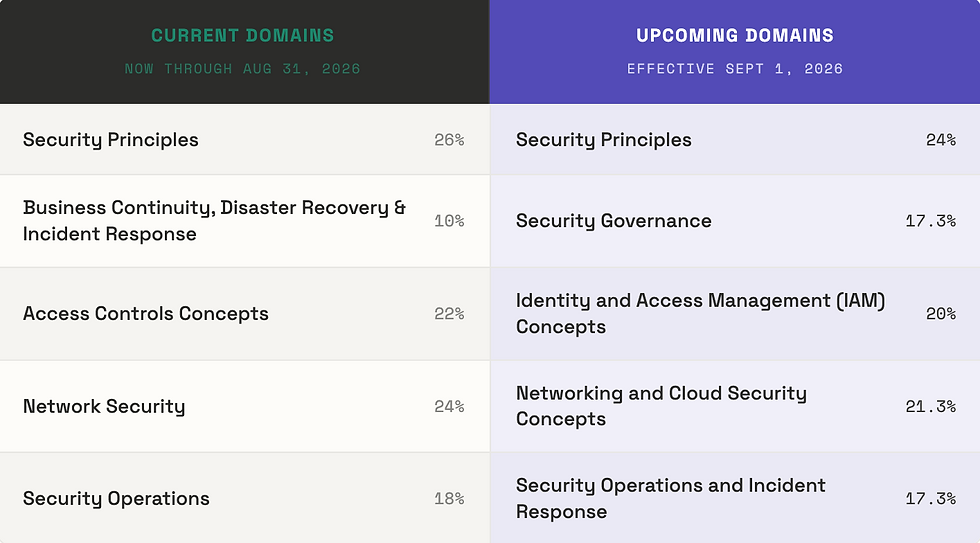
A few things jump out when you look at this side by side. Security Governance becomes its own domain in the new version — pulled out and given more weight, which reflects how much governance, risk, and compliance has grown as a discipline.
Cloud security gets formally added to the networking domain name, which makes sense given where the industry has moved. And BC/DR, which had its own domain at 10%, gets folded into Security Operations and Incident Response — suggesting those concepts are being treated as integrated practice rather than a separate planning track.
None of this changes what's worth learning. It changes how it's labeled and weighted. The fundamentals are the same.
What This Means If You're Considering the CC
💬 For non-IT career changers
You don't need to have configured a firewall or managed a server to pass this exam. You need to be able to think about why those things exist and what problem they solve. The CC is designed as an entry point — it tests foundational reasoning, not deep technical implementation.
What will help you most is mapping your existing experience onto the domain concepts before you study them cold. Find your Domain 5 — the place where your current skills overlap most naturally — and let that be your anchor. Then build outward from there.
And on Domain 4: don't skip it. Don't deprioritize it. That's the lesson I'd send back to myself at the start of this prep cycle.
The CC isn't the finish line — it's the first marker on a longer road for many. For me, it's the start of a roadmap that runs through Security+, AWS Cloud Practitioner, and eventually CySA+. But every road starts somewhere, and this one starts with being able to think across all five of these domains at once.
Five days from now, I'll find out how well I've done that. I'll tell you everything on June 21.
Disclaimer: ISC2 owns the CC certification and its exam domains. This post reflects my personal learning experience and is not affiliated with or endorsed by ISC2.
What's Next
My ISC2 CC exam is June 20. The full debrief — pass or fail, honest and complete — goes up on June 21.
If you're considering the CC yourself or navigating your own career pivot into cybersecurity, follow along. I'm documenting everything so you don't have to figure it out from scratch.
Also check out last week's post: I Did Microsoft's AI Skills Fest 8 Days Before My CC Exam — it's the most useful accidental study session I had in this whole prep cycle.


Comments